Issue 273 of the Reform Index, covering the period from September 8 to 21, features nine reforms.
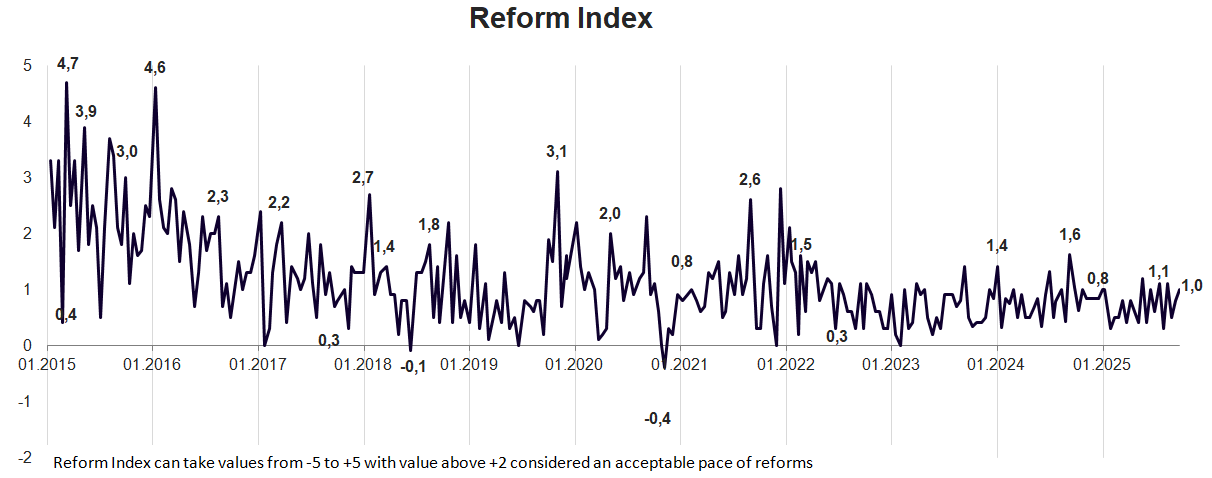
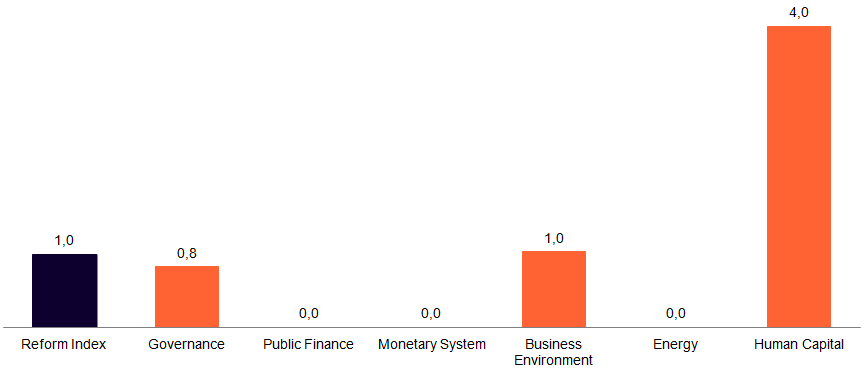
The headline achievements are the law establishing the Military Ombudsman (+2 points) and the law on vocational education (+2 points). However, the issue also contains developments that received mixed assessments from our experts: the first is the law restricting access to part of state registries during wartime, with expert scores ranging from a high of +2 points to a low of −4; the second is a resolution that moves the permitting process for work on heritage sites to a digital format and shortens the approval period to ten days, with scores ranging from −2 to +1. On average, both events received 0 points. The overall Index score is +1 point, up from 0.8 in the previous issue.
Graph 1. Dynamics of the Reform Index
Graph 2. Values of the Reform Index and its Components in the Current Assessment Round
Law on the Military Ombudsman, +2 points
On September 19, 2025, Ukraine introduced the position of Military Ombudsman, who will oversee the protection of the rights of service members, veterans, and their families. Previously, these issues fell under the mandate of the Human Rights Commissioner of the Verkhovna Rada, whose role was largely advisory and, in military matters, dependent on the position of the Ministry of Defense. The Commissioner could draw the attention of senior officials to problems, initiate inspections, or propose solutions, but lacked real autonomy from the Defense Ministry. By contrast, the Military Ombudsman is an independent institution accountable to the Verkhovna Rada, with its own secretariat, a separate budget, and powers that ensure its independence.
Information about the Reforms Index project, the list of Index experts and the database of the regulations assessed are available here.
Expert commentary
Anhelina Slavych, coordinator of the hotline at the NGO Legal Hundred
“The law on the Military Ombudsman is an important step toward protecting the rights of service members. The document regulates key issues related to the ombudsman’s status and their powers in the field of military rights protection.
Among the key changes worth noting are the following:
- A new institution has been established in Ukraine to protect the rights of service members across all military formations (the Armed Forces, the State Border Guard Service, the National Guard, etc.).
- The Military Ombudsman has the authority to review complaints, conduct inspections, obtain responses to inquiries, and receive immediate access to meetings with commanders or relevant officials to defend service members’ rights. He also has the right to unhindered access to military facilities.
- The Military Ombudsman may not disclose information about the private lives of complainants or other individuals involved in a complaint without their consent. This serves as an additional safeguard for the rights and interests of service members who choose to submit complaints.
- Complaints submitted to the Military Ombudsman must be reviewed within no more than 10 working days from the date of receipt. However, if the content of a complaint suggests a potential threat to life or health, the review period may not exceed 3 days.
- Anonymous complaints are permitted, but only if they concern a specific violation and contain clear, verifiable information. This safeguard is particularly important because, without the possibility of filing anonymous complaints, service members often choose not to seek protection of their rights.”
Vocational education reform, +2 points
On September 12, 2025, a new law, “On Vocational Education,” entered into force. Its adoption was one of Ukraine’s commitments under the Ukraine Facility program.
From now on, vocational schools, higher vocational schools, and workforce training centers will gradually transition into vocational colleges. They will be able to operate as nonprofit associations, giving their leadership greater financial flexibility — including the ability to allocate funds more efficiently and raise salaries for the best teachers and vocational-training instructors. In addition, any vocational education institution may obtain the status of a professional development center for the advancement of specific sectors of the economy.
The law also updates the substance of vocational education, aligning it with the National Qualifications Framework. Previously, programs were rigidly standardized, approved centrally by the Ministry of Education, and responded only weakly to changes in the economy. Now, the law allows educational standards to be updated on the basis of professional standards developed with the participation of employers and expert communities. This allows for quicker consideration of economic shifts (for example, the emergence of new technologies or specializations) and to update curricula without the need for a lengthy bureaucratic procedure.
In addition, the law formally recognizes dual education as one of the official formats for obtaining vocational training — where part of the instruction takes place directly at enterprises.
Another important innovation is independent qualifications assessment. Beginning in 2027, graduates studying at public expense will receive their diplomas only after successfully passing an independent qualification test administered at designated centers.
Expert commentary
Vira Ivanchuk, analyst at KSE, chair of the Public Council under the Ministry of Education and Science
“Updating the law on vocational education was extremely necessary, since the previous version had not been revised for more than 25 years and no longer met today’s challenges. First and foremost, the new law grants institutions far greater financial autonomy — the ability to manage their assets, determine staffing, and set their own pay systems, which makes governance more flexible and effective. Funding will shift from traditional budget maintenance to formula-based distribution with key performance indicators — meaning that results will become the basis for supporting institutions.
One of the main innovations is the introduction of public–private partnerships, which previously did not exist in the vocational education system. Another important change is that graduates will now receive a specialist diploma coupled with a certificate from a qualifications center that confirms the actual level of their practical skills. The autonomy of vocational education institutions is also expanding — they will be able to develop short-term and nonformal programs, establish their own qualifications centers, and provide additional services.
The law reduces the number of institutional types from 18 to 8, which helps improve governance quality and concentrate resources more effectively. Oversight boards with employer participation will now be incorporated into institutional management, strengthening the link between education and labor market needs. Terminology has also been updated: instead of ‘vocational-technical’ education, the term ‘vocational education’ is now used, and ‘students’ replaces ‘pupils.'”
Closure of state registries, 0 points
Law No. 4576-IX restricts access to part of the state registries for the duration of martial law and for one year after it ends. From now on, electronic access to information on the location and cadastral number of real estate owned by all legal entities will be limited. Public databases will list only the region where an object is located rather than its exact address, and legal entities will be allowed to provide any contact address in the registries rather than their actual one. Access to data on intellectual property objects related to national security has also been restricted. In theory, the law is intended to enhance the security of defense enterprises, but it has drawn criticism from civil society organizations, which argue that it may complicate efforts to detect corruption.
Expert commentary
Pavlo Demchuk, senior legal advisor at Transparency International Ukraine
“This law restricts electronic access to information on real estate rights registered to any legal entity. This concerns cadastral numbers of land plots and details about the location of that real estate at any level below the regional one.
Such disproportionate and sweeping restrictions will make it harder to combat corruption. For investigative journalists, information about exact addresses and cadastral numbers is a crucial tool for uncovering suspicious links between legal and natural persons, as well as potential abuses involving real estate. It will become much more challenging to determine who actually owns hidden property registered to a legal entity.”
Shortening the permit issuance period for construction work involving heritage sites to 10 days and introducing the “silent consent” principle, 0 points
Resolution No. 1130 introduces an updated procedure for issuing permits to carry out construction work on cultural heritage sites, including architectural, archaeological, historical, and landscape monuments. The approval process for work on cultural heritage sites will now take place through an electronic system. The applicant submits project or scientific project documentation through an online portal, with no paper documents required. The cultural heritage protection authority has 30 days to approve project documentation and 10 days to issue a permit or a refusal for work on heritage sites via the electronic system.
The main innovation is that if the authority does not issue a refusal within 10 days, the project documentation is considered approved automatically, and the permit is deemed issued by default.
Expert commentary
Olena Pitirimova, architect
“This resolution updates the procedures for approvals and permits in the cultural heritage sector. The main change is the transfer of most procedures into the Unified State Electronic System in the Construction Sector (USESCS) and the introduction of clear deadlines for decision-making.
USESCS will now be used to approve programs and projects in heritage protection zones, to review scientific and project documentation, and to issue permits for work on monuments of national and local significance. Previously, these procedures were conducted in paper form outside the electronic system, which complicated oversight of deadlines and created delays.
Under the updated procedure, the heritage protection authority has 30 days to approve or reject scientific or project documentation, and 10 days to issue a permit for the work. If no decision is provided in a timely manner, the “silent consent” principle applies: the documentation is considered approved, and the permit is granted. For heritage sites damaged by hostilities, an accelerated procedure has been introduced: 5 days for document approval and 3 days for the permit (under the new amendments adopted by Resolution No. 1237 of October 1, 2025).
Overall, transferring approvals to USESCS makes the process more orderly. Applicants can view the status of their submission, including deadlines, the responsible official, the date a decision was made, and whether the deadline has expired. Moving these procedures into an electronic format does make the process more structured and predictable.
However, despite the clear advantages of digitalization, the changes carry several significant risks. First, there is the issue of staffing capacity within heritage protection bodies. Complex restoration or scientific project materials can include hundreds of pages of documentation, drawings, and research. Processing such volumes within 30 days is challenging, even for a well-resourced office. In many local communities, only a few people work on heritage issues, or there may be no specialists at all. Under such conditions, a significant portion of documentation may proceed under the principle of silent consent without substantive review.
Second, there is the problem of uneven levels of heritage protection across communities. In historic cities, the number of applications can be extremely high, which increases the risk of automatic approval simply because of time pressure. In smaller communities, the opposite problem arises — too few staff to handle even a single complex project. Formally, the rules are the same for everyone, but in practice, the quality of oversight may vary significantly.
Third, there remains a risk of abuse of the new rules. Under high workloads or staff shortages, some applicants may rely on deadlines expiring and obtain approval or permits automatically. This is especially critical for historic areas and protected archaeological zones.
In short, digitizing approvals in the cultural heritage sector is an important step toward streamlining procedures and enhancing transparency. However, the effectiveness of these changes depends on the real capacity of heritage protection authorities to work within the prescribed deadlines. Without additional support, training, and stronger staffing, the silent consent mechanism may become a tool that weakens oversight of interventions in heritage sites instead of one that accelerates procedures.”
Reform Index from VoxUkraine aims to provide a comprehensive assessment of reform efforts by Ukraine’s authorities. The Index is based on expert assessments of changes in the regulatory environment in six areas: Governance, Public Finance, Monetary system, Business Environment, Energy, Human Capital. Information about the Reforms Index project, the list of Index experts and the database of the regulations assessed are available here.

Attention
The author doesn`t work for, consult to, own shares in or receive funding from any company or organization that would benefit from this article, and have no relevant affiliations