The third quarter brought a long-awaited acceleration of reforms: whereas since early 2024 we had recorded up to 40 significant changes per quarter, this time the Reform Index registered 63 notable regulatory measures. Yet the news was not entirely positive, as two of them were counter-reforms. A scandalous law that curtailed the powers of the National Anti-Corruption Bureau (NABU) and the Specialized Anti-Corruption Prosecutor’s Office (SAPO) became one of the most far-reaching anti-reform measures in ten years of monitoring, while the other was a Cabinet of Ministers resolution allowing religious organizations to obtain religious property for ten years of free use. More on these developments — and on the positive reforms — below.
Figure 1. Initiators of regulatory acts classified as reforms in the Reform Index
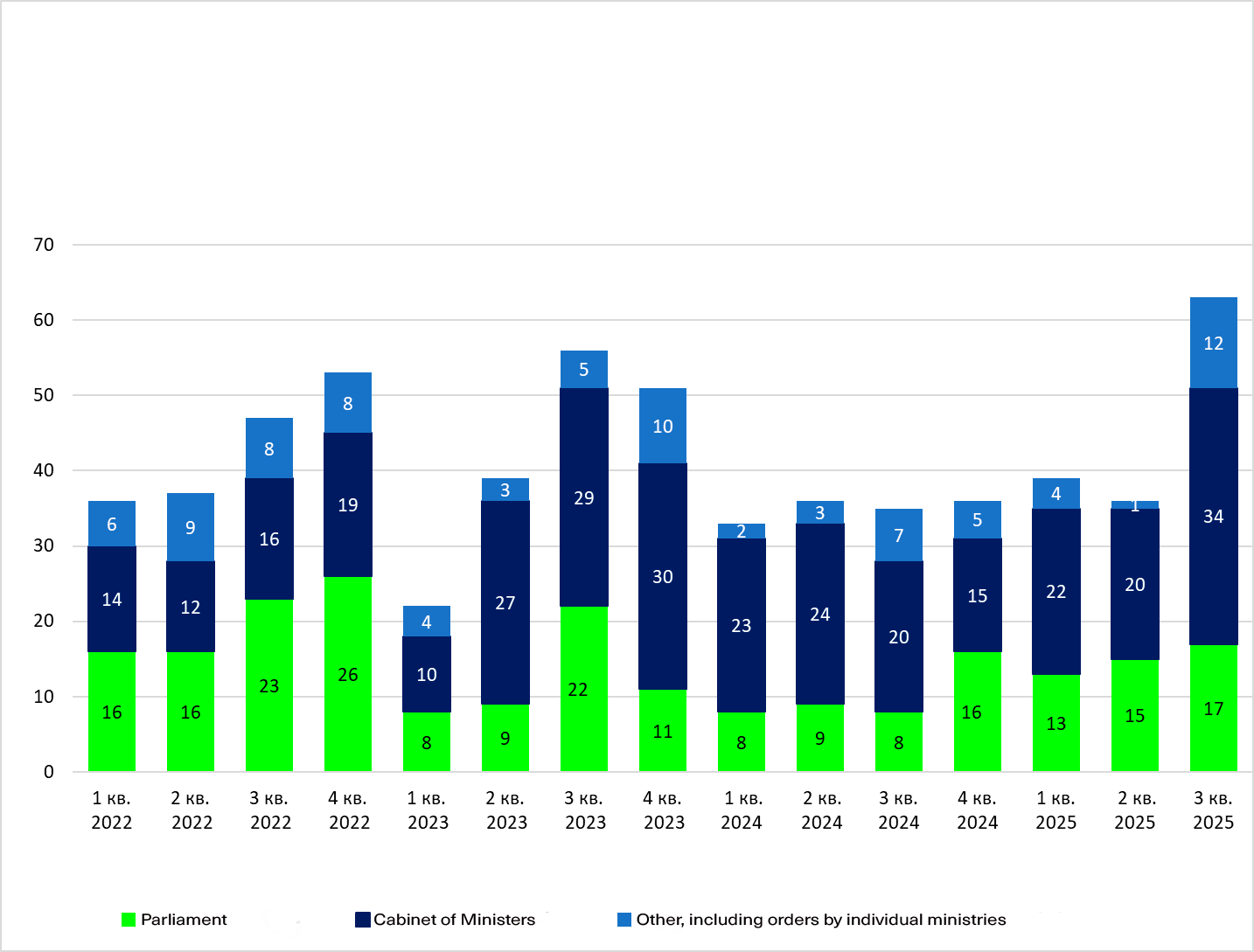
The government continues to be the main driver of reforms in Ukraine. It was largely thanks to the new government led by Yuliia Svyrydenko accelerating the pace of reforms (Figure 1) that substantial progress was achieved in the third quarter. Overall, this is the second-best result during the tenure of President Volodymyr Zelensky and the 9th convocation of the Verkhovna Rada. The Ukrainian bodies had managed to work faster only during the initial “turbo mode,” initiating 71 significant changes in the last three months of 2019. This time, the government, Parliament, the President, and the National Bank together delivered 63 such changes.
Anti-reform measures
However, the rapid pace was overshadowed by one of the most significant counter-reforms in the ten-year history of the Reform Index. A draft law titled “on the specifics of pre-trial investigation of criminal offenses related to the disappearance of persons under special circumstances during martial law,” which initially consisted of only two paragraphs, was unexpectedly supplemented before its second reading with provisions expanding the powers of the Office of the Prosecutor General, effectively subordinating NABU and SAPO to it (-4.5 points on a scale from +5 to -5). When signing the law, the President commented that it was a step toward overcoming “Russian influence.”
Around the same time, information emerged that the anti-corruption agencies were preparing charges against individuals close to the President, including Timur Mindich, co-owner of the company “Studio Kvartal 95.” This information was later confirmed. After audio recordings were released as part of Operation “Midas,” Timur Mindich fled the country, and Andrii Yermak, head of the Office of the President, resigned.
This counter-reform triggered protests in many Ukrainian cities, forcing the authorities to partially roll back the law’s provisions. A new law, No. 4560-IX, adopted for this purpose, received 2 points in the Reform Index.
The second counter-reform was a Cabinet resolution granting religious organizations the right to use religious property free of charge for up to ten years (-0.5 points). In addition to reducing revenues to local budgets from rent, the decision has other shortcomings: the resolution does not include a procedure for situations in which multiple organizations claim the same facility. Because local authorities will decide at their own discretion, this creates corruption risks.
50/50
Three regulatory acts adopted in the third quarter received a score of zero because Reform Index experts gave them both positive and negative assessments.
A law raising the threshold for punishing officials for inaccurate asset declarations received scores ranging from -3 to +1, with a median of 0. Among its positive elements is the clearer division of investigative powers between anti-corruption and economic law enforcement bodies. The law explicitly defines which articles will fall under the jurisdiction of the Bureau of Economic Security — including the acquisition and sale of counterfeit money, unlawful actions involving payment cards, and smuggling of cultural property. It also sets time limits for storing information about corrupt officials in the Register of Offenders: one year for those who received administrative penalties, five years for legal entities, and until expungement of conviction for those held criminally liable. On the other hand, the law raises the monetary thresholds at which liability begins. Administrative liability for inaccuracies in a declaration now applies when the discrepancy ranges from 150 to 750 subsistence minimums for working-age persons (in 2025, UAH 454,200 – UAH 2,271,000). Previously, the administrative liability range was 100 to 500 subsistence minimums (UAH 302,800 – UAH 1,514,000). Accordingly, criminal liability now applies when the discrepancy exceeds 750 subsistence minimums. In addition, the law raises the threshold for confiscating assets that do not correspond to an official’s income level. Previously, assets could be confiscated if their value exceeded an official’s income by 500 subsistence minimums; now the difference must be 750 subsistence minimums.
The second law, which restricts access to state registers and scored 0 points, received expert scores ranging from -4 to +2. Lawmakers hope that concealing the actual location of businesses and their assets will help protect critical enterprises from Russian attacks. Data on intellectual property objects linked to national security will also be classified. On the other hand, civil society organizations note that the new provisions complicate corruption investigations.
The third regulatory act with a median score of 0 (scores ranging from -2 to +1) was a government resolution requiring cultural heritage protection bodies (the Ministry of Culture and the cultural departments of territorial communities) to respond quickly to requests concerning work on cultural heritage sites — architectural, archaeological, historical, and landscape objects. Within 30 days, they must provide a response approving or rejecting project documentation, and within 10 days, a response on the permit to perform the work. If no answer is given within these deadlines, the project is automatically considered approved and the permit granted. The resolution was introduced due to the need to rapidly restore structures, given the availability of funding. But experts also point to risks. Complex project documentation may run to hundreds of pages, and if a community has a large number of cultural heritage sites, it may simply be unable to process all requests in time. As a result, under the “silent consent” rule, weak or poorly designed projects may end up being approved.
Positive developments
Among the 58 positive changes, the highest score was awarded to the factoring law — 2.5 points on a scale from -5 to +5. Factoring is a service in which a company “sells” its client’s debt to a specialized factoring company (a factor) and immediately receives most of the funds without waiting for the client to pay. The key innovation is the planned creation of a special debt register, which the government must launch by July 30, 2026, when the law enters into force. Because current legislation lacks such a register, fraudsters have been able to sell the same debt to multiple companies simultaneously. The register of assignments of monetary claims will record every transfer of a debt. The government also plans to launch a national digital factoring platform where companies will be able to list their clients’ debts through an open electronic auction. Factoring agreements are an important tool for quickly securing working capital, which is particularly relevant for enterprises fulfilling government contracts, where post-payment is standard practice.
In addition to the factoring law (scored at +2.5 points), a high score — 2 points, which in our view distinguishes major reforms from less prominent ones — was awarded to 10 other regulatory acts. They are shown in Figure 2.
Figure 2. Key reforms of the third quarter of 2025
All expert assessments of regulatory acts from the Reform Index are available here.
Progress by Reform Index areas
Over the three months, the largest number of changes occurred in the Human Capital area. There was also notable progress in Governance (although this area also saw two anti-reform measures) and in the Business Environment. No reforms were recorded in the Energy sector.
Figure 3. Total event scores by area, Q3 2025
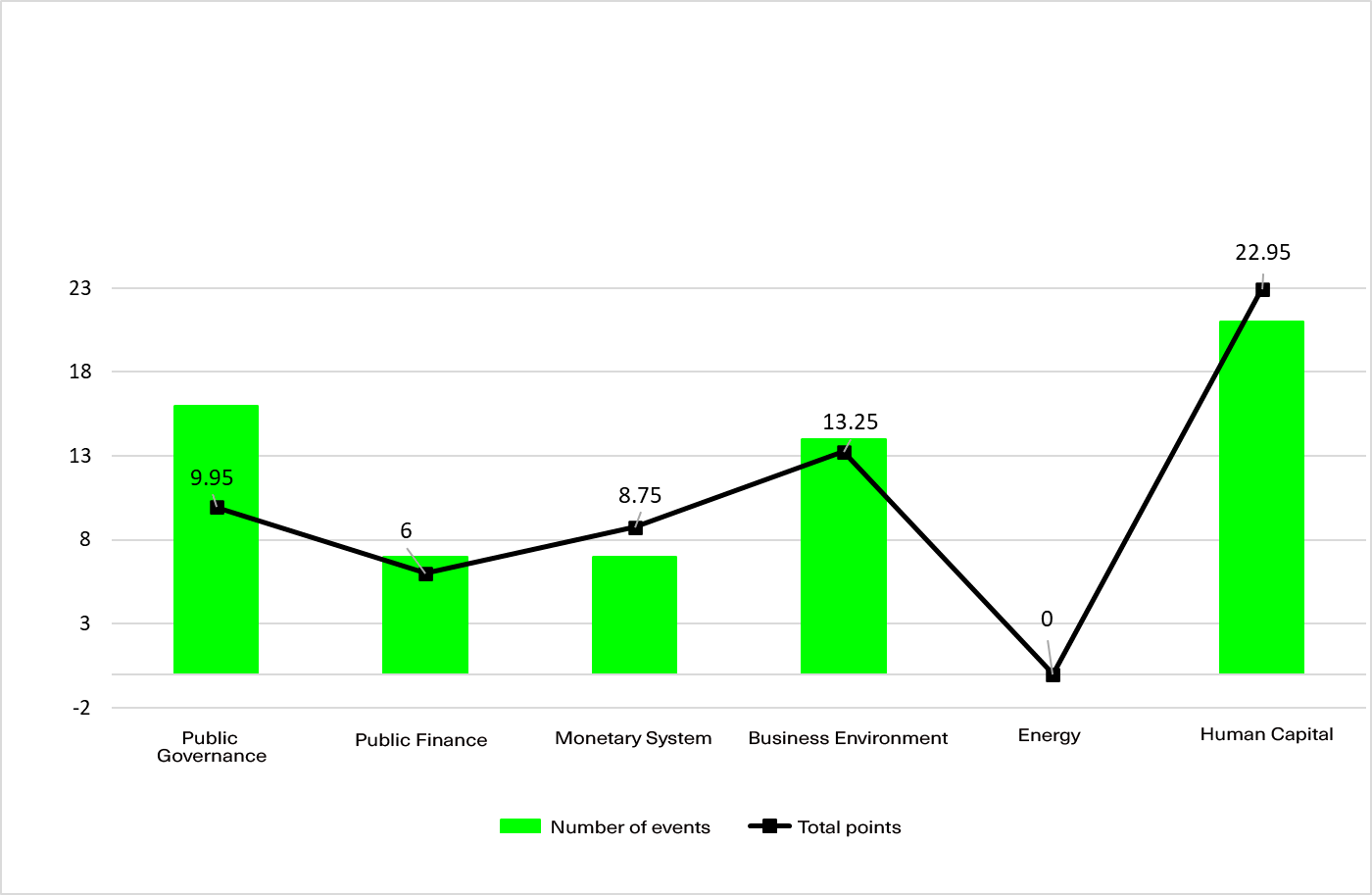
Source: Issues 268–274 of the Reform Index. Although these issues included 63 regulatory acts, the figure shows 65, because two of them fall under two areas simultaneously (the law on public–private partnership appears in both Governance and Public Finance, and the Defence City law appears in both Governance and the Business Environment).
Figure 4. Average quarterly Reform Index score
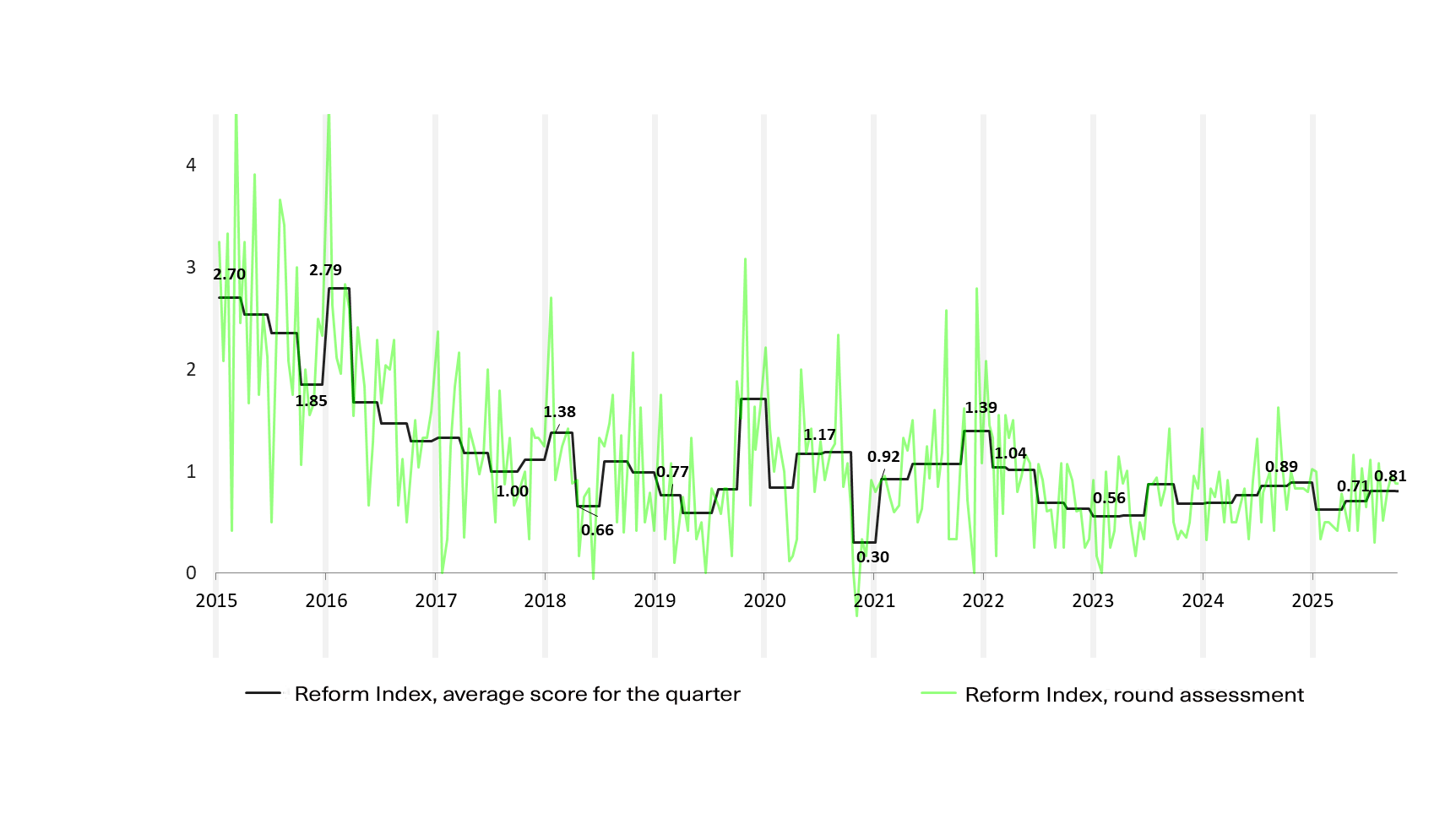
Source: Issues 1–274 of the Reform Index
Overall, in the third quarter of 2025 compared with the previous quarter:
- The number of significant changes nearly doubled — from 36 to 63
- The average score of the round increased slightly but remains very low — from 0.7 to 0.8 points on a scale from -5 to +5
- The average score per event fell from 1.2 points to 0.9 points
Reforms by area
Business regulation. The law on public–private partnership (2 points) introduces a simplified procedure for concluding contracts for projects aimed at restoring the economy and infrastructure during the war and for seven years after its end, as well as for projects costing up to EUR 5.5 million. Under the simplified procedure, a potential investor must submit a concept note for the project and receive a response within 45 days from the local council (village, settlement, city, district, or regional) on whether the project is deemed appropriate. Under the standard procedure, in addition to the concept note, the investor must submit a feasibility study, and local authorities have 90 days to provide a response. The law also initiates the creation of an electronic trading system (ETS) for concession projects aligned with EU standards and procedures. Everything will take place online — from the publication of the competition announcement to the disclosure of the signed contract. The law guarantees “legislative stability” for the investor: for the duration of the agreement, the legislation that applied at the time of signing will continue to apply.
In the third quarter, the government tightened requirements for the gambling industry (1 point). First, requirements for gambling operators have become stricter. After the scandal involving the company Parimatch, which was found to have ties to Russia, applicants for a license must confirm the absence of such ties and demonstrate an impeccable business reputation. Second, operators must introduce self-restriction mechanisms for players, including time and spending limits. They are also prohibited from encouraging continued play through bonuses or alcohol. Third, the State Online Monitoring System will now track player activity and monitor in real time whether operators comply with the established rules. The tax service will also gain access to this system, which should put an end to the practice of operators underreporting their revenues.
The rules for conducting inspections within the framework of state oversight also changed (1.5 points) — a risk-based approach was introduced. On the one hand, this should reduce the influence of the “human factor,” as well as the risks of corruption and pressure when selecting inspection targets; on the other hand, it will allow inspectors to use their resources more efficiently by directing them toward enterprises with higher risk levels. Information about the inspection plan and its results will be published on the website of the State Regulatory Service and on the open data portal.
Another step toward reducing the influence of the human factor on decisions concerning businesses is the automation of reviewing complaints about the actions, inaction, or decisions of licensing authorities (0.75 points). All complaints will now be processed in an online system — the Register for Reviewing Complaints of License Applicants and License Holders regarding decisions, actions (or inaction) of licensing authorities that violate licensing legislation. A complaint submitted online, along with information about the applicant, will be automatically entered into the system.
State property. In the fall, the government updated rules for accounting for and assessing mineral resources (1.25 points). From now on, reserves and resources will be classified according to a scheme aligned with the UN Framework Classification for Resources (UNFC). A key change is that the classification of minerals will take into account the feasibility, cost, and thus the economic viability of extraction. Deposits will be divided into viable (where resources are well studied and extraction is feasible and economically justified), potentially viable (where the efficiency of extraction cannot yet be determined unambiguously), and non-viable (where extraction is unprofitable and technically difficult).
To improve the efficiency of using state-owned property on the balance sheet of government bodies, the government approved rules for transferring such property for use by state and municipal enterprises (usufruct) (0.5 points). This transfer is permitted only for property that cannot be privatized. For example, under these rules, assets of the defense-industrial complex may be transferred for use for five years or on a permanent basis. Each year, the user of the property must prepare a report on its use, and the owner must analyze it. If the condition of the property has deteriorated, the user must return it to the owner, compensate for losses, or restore the asset.
Tax incentives and economic support. During the third quarter, the government adopted the Defence City law, which establishes a new tax regime for defense enterprises (1.5 points). Defence City residents were granted the right, until 2036 or until Ukraine joins the EU, not to pay corporate income tax if they reinvest it in the production of defense goods. They will also be exempt from environmental, land, and real estate taxes. In addition, these enterprises received customs benefits (1 point), such as expedited customs clearance for equipment imported for processing or temporary use, without the need for repeated declarations, including after modernization or repair. They will also benefit from simplified arms export procedures: they only need to obtain a license by paying a special fee to the Ministry of Defense, without waiting for Cabinet decisions or additional approval documents.
During the same period, Parliament adopted the law on veteran entrepreneurship (1 point). Businesses that receive this status from the Ministry for Veterans Affairs will have priority access to grants, subsidies, and business support programs. To give the provision practical content, the law stipulates that at least 10% of the budget of entrepreneurship support programs must be allocated specifically to veteran-owned businesses. Another benefit is the right to rent state or municipal property without an auction. To do this, a representative of the business must submit a request to the property owner via the electronic trading system. The decision and the lease agreement will also be published there.
Mobilized individual entrepreneurs (FOPs) also received the right to benefits (1 point): they were exempted from paying the single tax, the military levy, and the unified social contribution (if the FOP has no employees), as well as personal income tax for the duration of their service during martial law. If an FOP has hired employees, they may authorize another person to pay their wages. In this case, the authorized person accrues the unified social contribution, and the FOP may pay it within 180 days after demobilization without penalties. If an FOP lost the status of a single-tax payer (a “simplified system” payer) due to nonpayment of tax obligations during mobilization or contract service, that status will be restored automatically.
Digitalization. The requirement to notify Ukrainians when their data are viewed in state registers was put into practical effect (2 points). Previously, Ukrainians had to contact the register administrators themselves to obtain such information. Now, if a register is integrated with Trembita, a notification about the viewing of a person’s data will automatically be sent to the Diia app. The only exceptions are requests for data related to healthcare or criminal investigations.
In the third quarter, Ukraine introduced the Unified State Register of Military Personnel.(2 points). It will store information including full name, date of birth, gender, tax number or passport number, and military registration documents. A new element is the creation of the Military ID — an electronic identifier for service members. The register will be integrated with medical systems, so the results of medical examinations will be automatically uploaded. The first data entered will concern personnel of the Armed Forces of Ukraine and the State Special Transport Service. Later, it is planned to include information on all service members of the Defense Forces. The main risk remains cybersecurity, as any data leak concerning military personnel could have serious negative consequences.
The Cabinet of Ministers also adopted an updated regulation on the Unified Register of Powers of Attorney (1.25 points) — now, by scanning a document’s QR code via the Diia app, one can verify whether the document is present in the register. To obtain a copy of the document, the consent of at least one person named in it is sufficient.
To make digital services more convenient and improve internet performance, Ukraine permitted the use of a new wireless communication standard — Wi-Fi 6E (1 point). It uses the 6 GHz frequency band (5945–6425 MHz), which is not congested, since most devices currently operate at 2.4 GHz and 5 GHz. Another step toward ensuring high-quality digital coverage is a law that simplifies the allocation of land plots for developing digital infrastructure (1 point). Key changes include reducing the time required to allocate state and municipal land for this equipment from six to three months. Mobile operators were also allowed to place stations on land owned by others under land-easement rights — the right to use another party’s land for specific purposes without a lease or purchase agreement. Previously, operators could exercise this right only for underground communications.
Human capital. In the third quarter, the President signed the long-discussed law on multiple citizenship (2 points). For citizens of “friendly countries,” Ukraine will abandon the concept of sole Ukrainian citizenship. In particular, they will be able to acquire Ukrainian citizenship without being required to renounce their previous one. The state will recognize the existence of another citizenship if it was obtained by birth, adoption, marriage to a foreign national, or acquisition of citizenship of “friendly countries.” This will help maintain the country’s connection with citizens who left because of the war and will also simplify citizenship procedures for individuals who, for example, serve in the International Legion for the Defense of Ukraine and are willing to obtain Ukrainian citizenship but are not prepared to give up their existing one.
During the same period, the law on state policy of national memory was adopted (1 point). This is a framework law that defines what constitutes memory policy, crimes against the Ukrainian people, historical anti-Ukrainian propaganda, ruscism, and other related concepts. The Ukrainian Institute of National Memory becomes responsible for developing and implementing state policy in this field. In particular, it will maintain a list of individuals and events that either contain or do not contain symbols of Russian imperial policy.
Protection of service members’ rights. To strengthen the protection of service members’ rights, the law establishing the Military Ombudsman was adopted (2 points). Previously, these issues formally fell under the mandate of the Ukrainian Parliament Commissioner for Human Rights, whose role in this area was largely advisory. By contrast, the Military Ombudsman is an independent institution with its own secretariat, separate budget, and broad powers: reviewing complaints, conducting inspections, carrying out surveys, commissioning research, requesting information from state bodies (including information with restricted access), the right to immediate meetings with officials, and unrestricted access to military facilities. Each year, the Military Ombudsman will submit a report on their work to the President of Ukraine and the Verkhovna Rada. This report (excluding restricted-access information) will be published on the Ombudsman’s website.
The law on intellectual property rights to objects created by service members in the course of their duties (1 point) clarifies that personal non-property rights belong to the author, while property rights are held by the state through the body in which the service member serves. The author of an invention is entitled to fair remuneration.
Social protection. To ensure that barrier-free solutions are comprehensive rather than isolated, the government approved a procedure for establishing barrier-free routes in cities and communities (1 point). A “barrier-free route” is a transport and pedestrian path in which at least 75% of objects are adapted to the needs of users who experience difficulties with independent movement, communication, or access to services. This applies not only to sidewalks and roads but also to government buildings, educational institutions, hospitals, and public transport stops. Funding for such routes follows a 40–30–30 model: 40% from the state budget, 30% from the regional budget, and 30% from community funds. Existing barrier-free routes can already be found on a public map.
Housing was also in the focus of policymakers. The Cabinet of Ministers developed a procedure for establishing a municipal (social) rental housing fund (1 point). The housing will be leased on preferential terms to people in difficult circumstances. The project will be financed through local budgets, international assistance, and grants. At least 10% of such housing must be allocated to elderly internally displaced persons who do not own housing in government-controlled areas, to families that include persons with disabilities, and to large families.
The government initiated the creation of an information and analytical system of real estate objects to provide housing for internally displaced persons (0.75 points), which is to be launched by October 1, 2026. It will contain data on land plots, houses, and apartments. It will also include electronic accounts for internally displaced persons who wish to apply for residence in the available properties.
Steps toward the deinstitutionalization of care for orphans continue. The “family home” model of care for orphans and children deprived of parental care (1 point) provides that children (up to eight, or up to six if the children have disabilities) will live in separate adapted houses together with a team of specialists: a family caregiver, a social worker, a psychologist, and other specialists as needed. In such homes, children will have their own space and will gain experience in managing household routines, growing up in an environment as close to a family setting as possible.
In addition, the government formalized the social component of early intervention services (1.25 points). As part of a pilot project, the state will finance these services through contracts concluded with the Social Protection Fund for Persons with Disabilities. The monthly rate for the work of three specialists (a social worker, a psychologist, and an occupational or physical therapist) is UAH 115,200. The service will be provided in the child’s natural environment — at home, on a playground, and in similar settings. Its aim is to help parents develop the competencies needed for the child’s optimal development, provide psychological support when necessary, and prepare the child for entry into kindergarten.
Education. The law on vocational education (2 points) grants vocational institutions substantial autonomy. Previously, curricula were standardized and approved by the Ministry of Education. Now, vocational schools may update their programs based on professional standards developed with input from employers and professional communities. As a result, updating curricula will become significantly easier. Beginning in 2027, knowledge assessment will take place in the form of a qualification test conducted in specialized qualification centers established within vocational institutions. Graduates will be able to choose where to undergo such testing, except for their own institution’s center. Testing at the institution where the training took place will be allowed only if no other center in the region is available to assess the acquired skills. Another important change is that vocational education institutions may operate as non-profit enterprises — this will allow them to attract and allocate their own funds more flexibly.
To enhance the financial sustainability of educational institutions, the government expanded the list of paid services they may provide (1 point). For example, preschools may charge additional fees for child care beyond the state-guaranteed hours (currently up to 11 hours per day), for round-the-clock care, for additional extracurricular activities, and for extracurricular programs offered to children from other preschools. Institutions at other levels of education may charge for additional classes that are not included in their standard curricula.
During the same period, the government decided to consolidate all education-related information in the Unified State Electronic Database on Education (1 point). The database will contain all information — from the list of educational institutions and academic and teaching staff to the list of learners and documents on education and academic degrees. Through this system, applicants will submit online admission applications, and ranking lists of entrants as well as state and regional enrollment quotas will be generated. The system also allows for conducting surveys of educators and students and for monitoring the employment of graduates.
To ensure readiness for the rapid reintegration of de-occupied territories, the government approved updates to the personnel reserve for teachers from frontline regions (0.2 points). The new approach allows teachers who lost their teaching workload due to school closures to undergo training while receiving an average salary. In return, the teachers must commit to working in a school in a liberated territory for at least five years.
Healthcare. The government amended the rules for licensing medical practice (1 point). A license may now specify not only the types of medical care provided (primary, emergency, specialized, palliative, rehabilitative) but also individual medical specialties. This change is intended to ensure that the absence of a single specialist does not lead to the revocation of the license for the entire medical facility.
To improve access to medicines, the government simplified the rules for importing them into Ukraine (1 point). It is now clearly defined that medicines imported as humanitarian aid are not subject to state control — the recipient of the humanitarian assistance is responsible for their quality and safety. Patients’ access to innovative medicines obtained through managed entry agreements (1 point) has also increased. The adopted law allows the national agency Medical Procurement of Ukraine to purchase medicines under managed entry agreements using local budget and hospital funds. Previously, such agreements could be concluded only with state budget funds. Thanks to the confidentiality of data on the price and quantity of medicines, as well as direct contracts with manufacturers, this mechanism helps secure lower prices.
Six months after the end of martial law, a new procedure for certifying healthcare workers will enter into force (1 point). From that moment, the certification of doctors, nurses, pharmacists, rehabilitation specialists, and other healthcare professionals will be governed not by multiple documents but by a single nomenclature of specialties and a unified certification procedure. Certification will take place once every five years at the facility where the healthcare worker is employed. Upon completion, the specialist will receive a certificate granting or confirming their professional qualification. All healthcare workers (not only physicians) will be required to maintain a personal educational portfolio and keep a record of continuous professional development points (the annual minimum is 30 points for nurses and pharmacy assistants and 50 points for doctors and pharmacists). These educational portfolios will be taken into account during certification, and a separate portfolio will be required for certification in each specialty.
To support healthcare workers who choose to work in rural areas, the government approved rules for allocating funds to purchase housing for them (0.5 points). Using funds from the budget program “Provision of housing for healthcare workers to fill vacant positions in rural areas,” the Ministry of Health will channel money through the health departments of regional state administrations to municipal healthcare facilities for the acquisition of housing. The housing will be selected by the healthcare worker but will remain on the balance sheet of the healthcare facility. To qualify, the healthcare worker must be employed in a rural area in a position that has been vacant for at least 90 days. This opportunity may be used within the first 120 days after employment. The healthcare worker must be under 50 years of age and must not own housing within 30 kilometers of the facility.
Also in the third quarter, the government developed a unified procedure for medical examinations for anyone who wishes to take a child into their family (1 point). To undergo the medical examination, individuals must contact their family doctor, who coordinates the entire process, issues referrals, and prepares the medical conclusion. The examination is free for prospective adoptive parents, guardians, and foster carers.
Approaches to the rehabilitation of persons with disabilities also changed (0.75 points). The individual support plan will be based not on diagnoses but on the person’s actual needs across various domains: medical, social, professional, educational, physical activity, and others. A team of specialists will first assess the individual’s daily functioning and then develop a list of interventions to be implemented by experts from different fields. When preparing individual rehabilitation programs for children, the involvement of educators, social workers, and specialists from inclusive centers is envisaged. Participation of the person with a disability in the proposed activities is voluntary, but the programs are mandatory for all institutions involved in their implementation.
The ambition to secure rapid accession to the European Union requires maintaining a high pace of reforms. At the same time, the quantity must not come at the expense of quality. When comparing Ukraine’s lawmaking tempo with that of our European neighbors, we often exceed theirs several times over. However, Ukrainian policy decisions typically lack coherence and long-term vision, and important reforms can be rolled back at any moment — which is exactly how the quarter’s main counter-reform emerged, aimed at reducing the powers of NABU and SAPO. Only the vigilance of Ukrainians regarding the lawmaking process, supported by international partners, can prevent the degradation of Ukraine’s legislative landscape.
Photo: depositphotos.com/ua

Attention
The author doesn`t work for, consult to, own shares in or receive funding from any company or organization that would benefit from this article, and have no relevant affiliations