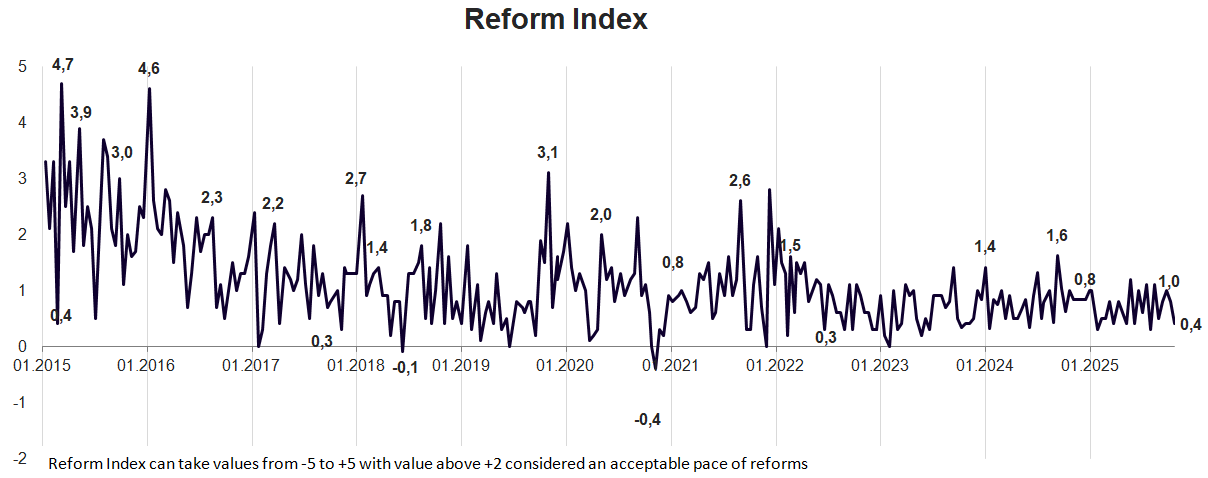
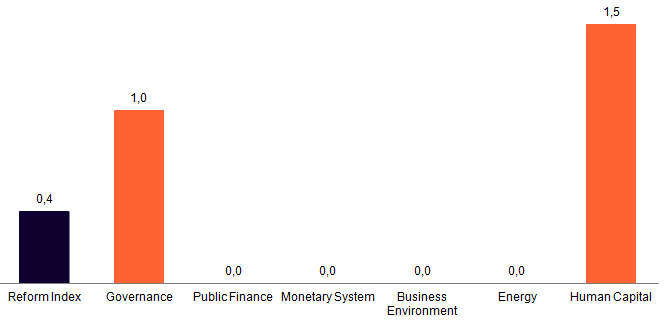
The 275th issue of the Reform Index, covering the period from October 6 to 19, includes only two reforms. A Cabinet of Ministers resolution specifying how employers must adapt workplaces for employees with disabilities received the higher score from experts — 1.5 points on a scale from −5 to +5. The launch of the “Pulse” information system, through which the government will interact with entrepreneurs, earned +1 point. The overall score of the Index in issue 275 is 0.4 points, which is half the level recorded in issue 274.
Graph 1. Dynamics of the Reform Index
Graph 2. Values of the Reform Index and its Components in the Current Assessment Round
Rules for equipping workplaces for persons with disabilities, +1.5 points
The Cabinet of Ministers has approved the Procedure for adapting workplaces for persons with disabilities. Until now, there were no unified rules, so approaches to organizing workplace conditions were left to the discretion of employers and often did not account for the specific needs of individual employees.
From now on, if an employee submits a request to arrange a workplace, the employer is required to assess the necessary changes on the next business day. Taking into account the employee’s health condition and their individual rehabilitation program (if available), the employer prepares a list of required adjustments that may be implemented through redevelopment, repairs, or additional outfitting of the workspace. Besides adapting the workplace, the employer must provide training on using special equipment and ensure its regular maintenance.
Importantly, the new system is based on an individual approach: adaptation depends on the specific type of disability. For example, for employees with visual impairments, the Procedure provides for tactile or contrasting elements, while for those with hearing impairments, it requires the installation of visual signals.
Workplace adaptation may be financed by the employer at their own expense, by the state fund for the social protection of persons with disabilities, or from other permitted sources. The employer may apply to the Fund for compensation or a subsidy. The State Labor Service then verifies the justification and cost of the adaptation, the employment conditions, and the employer’s contribution to co-financing. Based on the verification results, the Fund decides whether to disburse the funds. Compensation may be denied if the employer has wage or unified social contribution arrears, is undergoing bankruptcy or liquidation, if compensation has already been paid for that employee, or if the employer’s share of co-financing is under 10%.
Information about the Reforms Index project, the list of Index experts and the database of the regulations assessed are available here.
Expert commentary
Ihor Bevkh, legal adviser and analyst at the civil association “League of the Strong”
“The resolution establishes the procedure for the redevelopment and additional outfitting of premises to meet an employee’s personal needs. The document outlines the steps an employer must take to organize this process and assess the employee’s needs.
The resolution was developed to implement the Law of Ukraine ‘On the Fundamentals of Social Protection of Persons with Disabilities,’ which provides for the redevelopment, repair, and additional outfitting of premises to make them suitable for persons with disabilities, as established by the government.
At the same time, the law requires employers to ensure equal working conditions for persons with disabilities, in accordance with state standards for equipping workplaces to accommodate different types of functional loss. As a result, a conflict of norms arises: the Procedure details the procedural aspects of redevelopment and additional outfitting but does not contain a direct reference to state standards. This complicates the implementation of those standards and the reimbursement of costs to employers, as one regulation may prescribe certain requirements, and the Procedure may prescribe others.
According to the Procedure, an employer must undertake such work only if it does not constitute an ‘unjustifiable or disproportionate burden.’ However, current legislation does not define clear criteria for assessing such a burden. This creates a legal gap. Because of this, an employer may subjectively determine what constitutes a burden and refuse to implement a reasonable accommodation (for example, installing an elevator). Such an approach increases the risk of discretionary decisions and reduces the transparency of the process.
In addition, it would be appropriate to adopt a separate Cabinet of Ministers resolution establishing the procedure for reimbursing employers for the costs of providing reasonable accommodations in the workplace for individuals with disabilities, in order to encourage the practical application of these measures.
To summarize, the success of implementation will depend on the alignment between state standards for equipping workplaces and the newly created Procedure, as well as on the availability of financial support for employers.”
Reform Index from VoxUkraine aims to provide a comprehensive assessment of reform efforts by Ukraine’s authorities. The Index is based on expert assessments of changes in the regulatory environment in six areas: Governance, Public Finance, Monetary system, Business Environment, Energy, Human Capital. Information about the Reforms Index project, the list of Index experts and the database of the regulations assessed are available here.
Photo: depositphotos.com/ua

Attention
The author doesn`t work for, consult to, own shares in or receive funding from any company or organization that would benefit from this article, and have no relevant affiliations