Between October 20 and November 2, Index experts recorded 11 reforms. The key development of this issue is the introduction of mandatory accessibility compliance checks for all new building projects.
This reform falls under two policy areas — Business Environment and Human Capital — and has a combined score of +2.5 points (on a scale from -5 to +5). Also in focus are two reforms in the employment sector. The first digitizes employment procedures, while the second introduces proactive communication with unemployed individuals: the state will offer job-placement assistance before a person contacts the Employment Service. Experts rated these two reforms at +1.5 points.
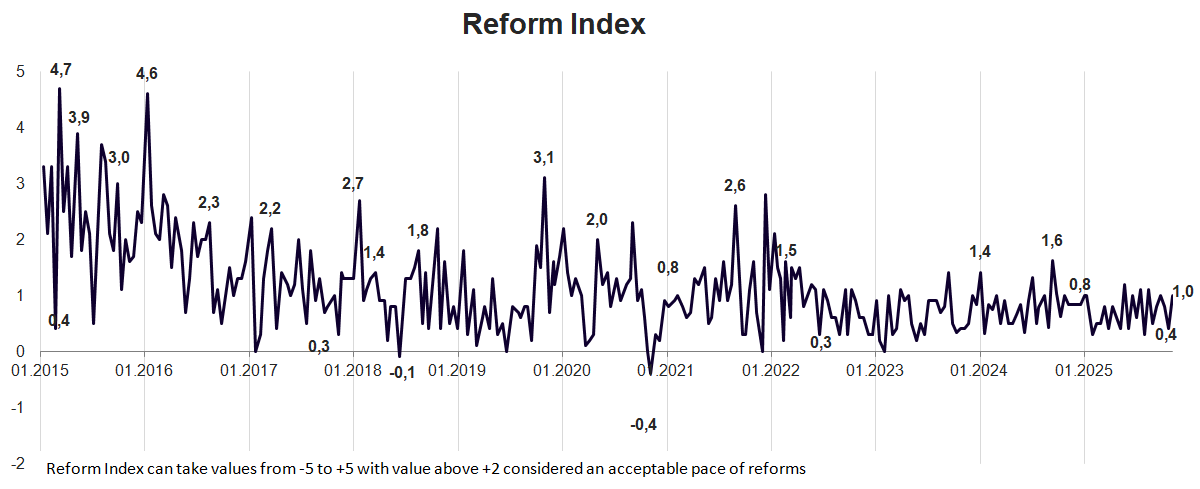
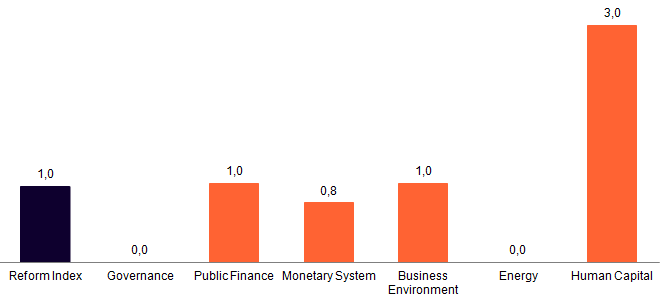
The overall Reform Index score in issue 276 is +1.0 point, up from +0.4 points in the previous issue.
Graph 1. Dynamics of the Reform Index
Graph 2. Values of the Reform Index and its Components in the Current Assessment Round
All construction projects will be checked for accessibility at the planning stage, +2.5 points
From now on, accessibility requirements must be taken into account at the building planning stage in Ukraine.
When uploading documentation to the Unified State Electronic System in the Construction Sector (USESCS), designers must complete an accessibility checklist to confirm that the project complies with barrier-free access requirements for persons with disabilities in key areas of the building. The checklist assesses, for example, whether elevators and ramps are provided, whether they meet established standards, and whether a person can use them independently to enter the building. It also covers the availability of parking spaces for persons with disabilities, sufficient corridor and doorway width, tactile markings, and hazard warning systems that convey information through multiple channels (visual, audio, and tactile), among other criteria.
Accessibility for low-mobility groups thus becomes a mandatory condition for the approval of construction projects.
Information about the Reforms Index project, the list of Index experts and the database of the regulations assessed are available here.
Expert commentary
Olena Pitirimova, architect
“Cabinet of Ministers Resolution No. 1376 introduces amendments to the Procedure for Maintaining the Unified State Electronic System in the Construction Sector (USESCS).
These amendments introduce a checklist to ensure construction projects are accessible to persons with limited mobility. The checklist contains a structured set of requirements for project documentation related to accessibility, including entrances and circulation paths, ramps and stairs, parking spaces, elevators and lifts, and information systems.
This checklist is included in the mandatory set of electronic documents generated within USESCS. It must be completed and submitted together with the construction project documentation uploaded to the system by the client or authorized participants in the process. It must also be included in the expert review report on project documentation, which is prepared and registered in USESCS by the expert organization.
The resolution does not change the accessibility requirements established by state building codes, nor does it expand the obligations of architects and designers. Project documentation must comply with existing standards, and accessibility solutions were previously reflected in drawings and explanatory notes. What changes is the way compliance with these requirements is recorded in the digital system: accessibility requirements are consolidated into a separate, structured data block that must be completed and registered in USESCS. This increases transparency in the system but also adds an administrative step.
At the same time, the introduction of a unified checklist may be useful not only for transparency but also for clients and asset holders who are not always well-versed in accessibility standards. Having a structured list of requirements as part of project documentation can serve as an additional self-check tool, particularly during the reconstruction or retrofitting of small facilities, where accessibility issues are often overlooked due to limited oversight.”
Oksana Kuziakiv, executive director at the Institute for Economic Research and Policy Consulting (IER)
“The resolution introduces a mandatory checklist in the Unified State Electronic System in the Construction Sector to ensure the accessibility of construction projects for persons with limited mobility. The document formalizes the inclusivity requirements set out in state building codes and integrates them into the digital design and approval process, thereby reducing the scope for discretionary interpretation.
For the state, this means stronger institutional oversight and better alignment of regulatory practice with international obligations in the field of the rights of persons with disabilities. At the same time, the effectiveness of this reform will depend on effective control over the accuracy of checklist completion and the availability of enforcement mechanisms for noncompliance.
For businesses, the resolution establishes clearer rules and reduces regulatory uncertainty but may lead to higher design and construction costs, especially for small facilities or reconstruction projects.
For citizens — particularly those with limited mobility — the decision has the potential for a positive social impact, as it aims to ensure comprehensive and safe accessibility of buildings. However, without adequate oversight, there remains a risk of merely formal compliance.”
Digitalization of employment services through the Obrii system, +1.5 points
Ukraine will introduce a new information system, Obrii, designed to digitalize interactions between unemployed individuals and employment centers. Users will be able to create a personal electronic account through which they can submit documents, obtain unemployed status, and interact with employment service consultants — exchanging messages, submitting documents, and receiving individualized recommendations on vacancies, retraining programs, and so on. Electronic accounts will also be available for employers, enabling them to post vacancies and participate in state employment support programs, including compensation schemes for hiring internally displaced persons or persons with disabilities, as well as grant programs.
An important innovation is the ability to assign and confirm professional qualifications online. This is particularly relevant in a rapidly changing labor market, where individuals often need to quickly acquire new skills or transition to new occupations.
Expert commentary
Stanislav Yukhymenko, research fellow at the Institute for Economic Research and Policy Consulting
“Cabinet of Ministers Resolution No. 1403 launches a two-year pilot project to introduce the digital employment system Obrii. The core idea of the service is to digitize as many employment-related processes for unemployed individuals as possible to reduce paperwork, simplify registration, improve employment outcomes, and provide the state with analytical data. Access to system functions will be provided through Diia.
Through Obrii, job seekers will be able to register as seeking employment, obtain or renew unemployed status, arrange benefit payments, receive job offers, access vocational training and qualification assignment or confirmation procedures, and participate in employment support programs. The system will automatically retrieve information from various state registries, meaning job seekers will not need to prepare additional certificates for data already held in government databases.
At the same time, several risks should be highlighted. The first concerns personal data security. The system will aggregate registry data containing large volumes of personal information, which means Obrii must comply with Ukrainian personal data protection legislation as well as EU General Data Protection Regulation (GDPR) standards, which Ukraine will be required to adopt in the course of EU accession.
The second risk is digital inequality. In Ukraine, there remains a segment of the population that does not use smartphones or does not wish to install Diia. For such individuals, offline access to services should be provided, potentially through Administrative Service Centers.
If Obrii functions as intended, it could significantly reduce the time between job loss and re-employment for job seekers.”
Proactive support for non-employed persons, +1.5 points
Starting in 2026, the government will launch a pilot project on proactive support for non-employed individuals. This initiative marks a shift in employment policy from a reactive approach — under which employment services, social benefits, retraining, or education were provided only after individuals sought assistance following job loss — to a proactive model, whereby the state engages with unemployed persons before they contact the Employment Service.
Under the new procedure, the Pension Fund and other state registries will automatically transmit information to the Employment Service about non-employed individuals — those who have not found employment or paid the unified social contribution within 60 days after dismissal. The Employment Service will then contact these individuals by phone, email, or through Diia and offer assistance with employment or retraining.
The project does not apply to persons with disabilities in Groups I–II, recipients of childbirth and caregiving benefits, or young people under 23 enrolled in full-time or dual education programs.
Expert commentary
Oleksandr Zholud, principal expert at the Monetary Policy and Economic Analysis Department of the National Bank of Ukraine
“Incentivizing and assisting people in finding new employment is a positive development. Economic research shows that the longer a person remains unemployed, the harder it becomes to find and retain a new job. Proactive work by the State Employment Service should therefore help people — especially those who lost their jobs for the first time or can no longer perform their previous work. This is particularly relevant for individuals injured as a result of Russia’s military aggression, whose injuries limit their work capacity.
Ukraine currently faces a situation that may appear paradoxical: a high unemployment rate (around 10% of the labor force, according to International Labor Organization estimates) combined with a chronic labor shortage reported by businesses. The core problem is a mismatch between available and in-demand skills. In this context, expanded opportunities for training and retraining are a positive development.”
Reform Index from VoxUkraine aims to provide a comprehensive assessment of reform efforts by Ukraine’s authorities. The Index is based on expert assessments of changes in the regulatory environment in six areas: Governance, Public Finance, Monetary system, Business Environment, Energy, Human Capital. Information about the Reforms Index project, the list of Index experts and the database of the regulations assessed are available here.
Photo: depositphotos.com/ua

Attention
The author doesn`t work for, consult to, own shares in or receive funding from any company or organization that would benefit from this article, and have no relevant affiliations