Support for Ukraine within the EU is uneven: in some countries, a strong majority favors Ukraine’s accession, while in others most citizens do not see Ukraine as part of the Union. In one of the key member states—Germany—public opinion is almost evenly divided. What can be done to shift public sentiment in Ukraine’s favor?
All EU countries except Hungary support Ukraine’s accession to the European Union. President Volodymyr Zelensky stated this during a meeting with journalists on October 9. The message appears optimistic, especially given that EU officials have repeatedly affirmed Ukraine’s European perspective in their public statements. Yet, as Eurobarometer surveys show (Figure 1), support for Ukraine is far from uniform—ranging from over 80% of citizens in Northern European countries to less than 33% in Czechia, Bulgaria, and Hungary. In Germany, opinions pro and contra Ukraine’s EU membership are evenly split: 47% / 47%.
At the same time, overall support for Ukraine’s accession has been declining. In 2022, 66% of EU citizens supported Ukraine’s accession once it was ready; in 2023, 61% supported its candidate status; in 2024—60%; and by 2025 only 52% of Europeans supported Ukraine’s accession to the Union.
Germany has traditionally been one of the most influential actors in the EU—as the bloc’s largest economy and an export powerhouse. Berlin helps shape the EU’s positions on the budget, the energy transition, and defense cooperation. Moreover, Germany is the largest net contributor to the EU budget. For these reasons, Ukraine’s prospects perception by German politicians, media, and voters will significantly influence the ability to reach a European consensus.
Figure 1. Percentage of EU citizens who support the accession of new member states to the Union
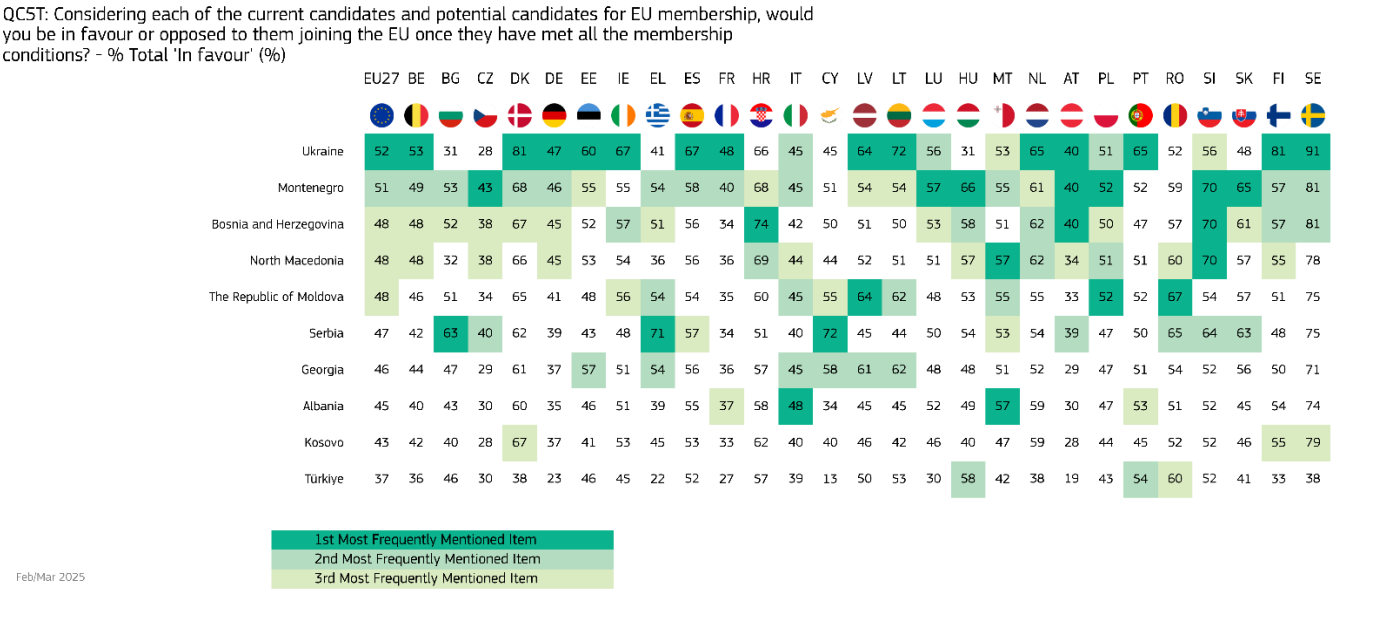
Source: Special Eurobarometer 564. Attitudes Towards EU Enlargement. p. 35
Germany is also the largest European donor of military aid to Ukraine. This is particularly important because public, political, and military support for Ukraine in Germany grew only gradually—and could therefore decline again. On February 25, 2022, Germany sent Ukraine 5,000 helmets as “security assistance.” At that point, the federal government refused to supply weapons altogether. Later, Germany began providing packages of light arms, ammunition, grenades, and similar equipment. It was only on June 21, 2022 (at least officially), that the first batch of heavy weaponry—Panzerhaubitze 2000 self-propelled howitzers—arrived in Ukraine. Since then, the volume of German assistance has grown steadily and, according to the Kiel Institute for the World Economy, reached USD 21.29 billion as of June 30, 2025. This makes Germany the third-largest donor after the United States (USD 114.63 billion), whose support has decreased significantly since Donald Trump took office, and the European Union as a whole (USD 63.13 billion). Moreover, because Germany is the EU’s largest net contributor, a substantial share of the EU’s assistance has been financed with German funds.
This is why the current political dynamic in Germany is cause for concern. The Alternative for Germany (AfD), which openly criticizes support for Ukraine, continues to strengthen its position. According to Bild, the latest nationwide poll places the AfD in first place with 26% support. For comparison, in the previous federal elections in 2025 the party received 20.8% of the vote, taking second place, while in 2021 it won only half that amount (10.4%).
The AfD plays on voters’ fears of economic decline, of the country being “dragged” into the war, and of rising energy prices. AfD’s arguments indeed have some ground. The German economy is going through a challenging period: minimal GDP growth of 0.2%, inflationary pressures, rising energy costs, and the effects of deindustrialization. For these reasons, German skepticism toward further EU enlargement has a rational foundation—linked not only to Ukraine, but also to the likely need to provide financial support to new member states.
Indeed, according to the Eurobarometer survey mentioned above, nearly half of German citizens (47%) believe that EU enlargement would mean an additional financial burden for taxpayers. Another set of concerns is institutional: the same share of respondents (47%) point to the risk of decision-making becoming more difficult in an expanded EU. Meanwhile, 45% worry about corruption and organized crime, and 43% fear uncontrolled migration. These arguments are actively exploited by right-wing political forces, turning economic anxiety into a political weapon. For now, this is not enough for the AfD to come to power. However, if its rise in popularity continues, such an outcome becomes entirely plausible. As a result, Ukraine would not only lose a substantial share of financial assistance, but its prospects for EU membership would become far more elusive.
Yet German public opinion on EU enlargement is not uniformly negative. More than half of respondents (53%) see enlargement as an opportunity to strengthen the economy and competitiveness; 43% view it as an opportunity to enhance the EU’s influence on the global stage; 36% see it as a guarantee of greater security; and 37% regard it as a chance to create new jobs. In other words, for Germans the issue of enlargement is primarily utilitarian. This is precisely why Ukraine needs to demonstrate that its EU membership aligns with Germany’s interests—that is, to make clear that Germans have reason to continue supporting Ukraine, including on the path toward integration.
Figure 2. What EU citizens expect from the enlargement of the Union
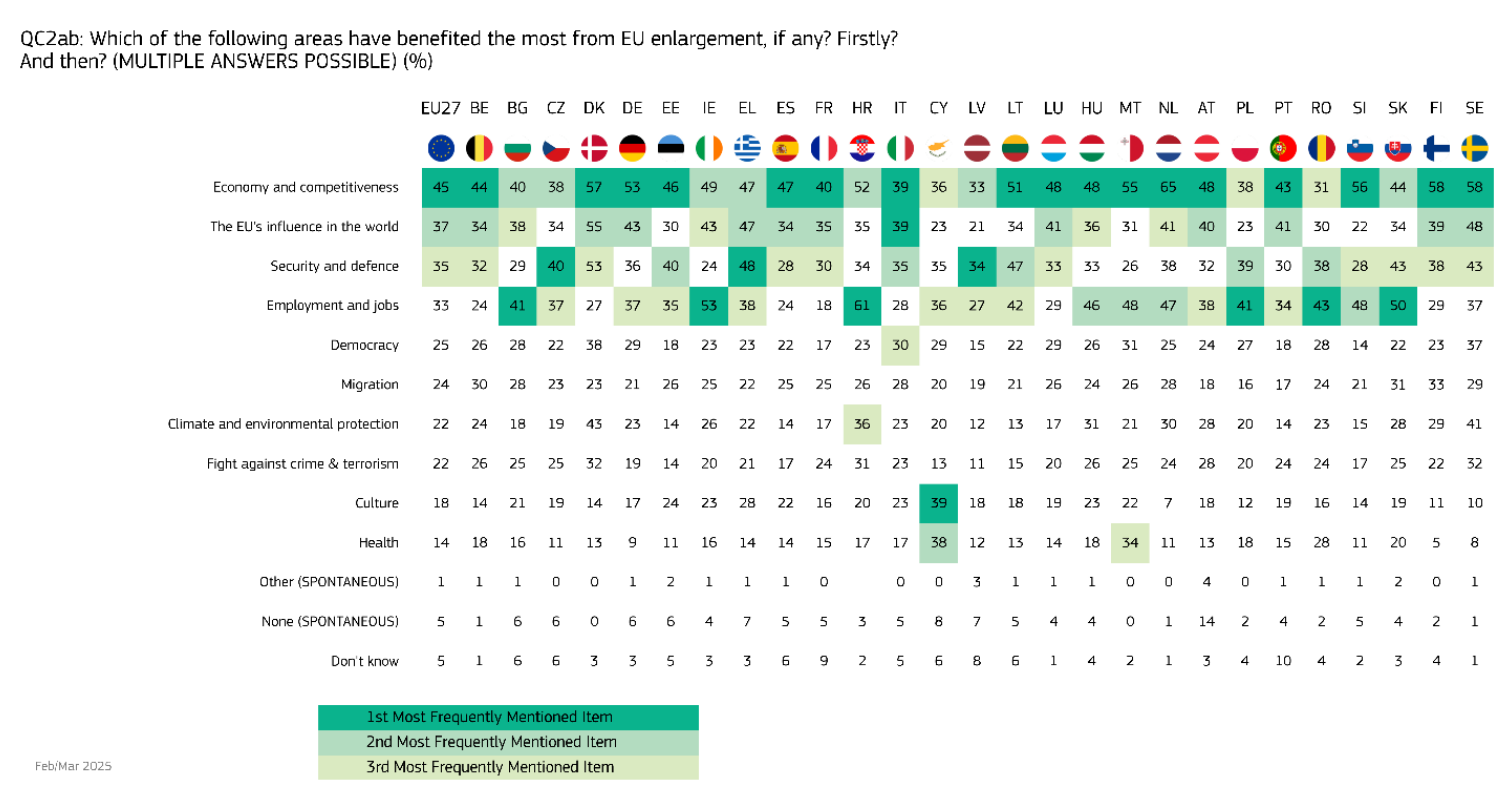
Source: Special Eurobarometer 564. Attitudes Towards EU Enlargement, p. 23
What narratives should Ukraine use?
Given that the German debate on EU enlargement prioritizes issues of economic performance and competitiveness, strengthening the EU’s global influence, creating new jobs, and security and defense, Ukraine’s communication should position our country as one capable of reinforcing the EU precisely in these areas. This approach not only helps neutralize populist messaging, but also fosters a sense of shared interests among the German public—something essential for building long-term consensus in favor of Ukraine’s membership.
Since the AfD actively exploits these themes, Ukraine’s communication strategy in Germany should co-opt them—demonstrating that enlargement is not a threat but a stabilizing factor, a way to strengthen the economy and security of both the EU as a whole and Germany in particular. In other words, the task is not to contradict the AfD’s messages or those of other populist parties, but to outplay their narratives by presenting the same issues in a positive light. Ukrainian officials already use a similar approach in their messaging. For instance, Ukraine’s ambassador to Germany, Oleksii Makeiev, emphasizes in his public comments that Ukraine’s integration would expand opportunities for electricity and energy trade within the single market. He reframes a sensitive topic for Germany—one frequently raised by the AfD—to promote Ukraine’s interests.
However, for these narratives to reach beyond expert circles, Ukraine should work more actively with formats that can engage a broader audience. Limited budgets can be offset by substantive collaborations—for example, short documentary videos, public lectures, or joint podcasts with German journalists, experts, and influencers who already have the trust of large audiences. Particular attention should be paid to social media. According to a 2022 Pew Research Center survey, people in developed countries generally consider social media useful for raising public and elected officials’ awareness of specific issues. In Germany, this share reached 70%. And although the same survey shows that only 50% of Germans believe that social media directly influence political decisions, that is still a significant number. Eurobarometer data for 2023 indicate that an average of 59% of EU citizens use social networks. In Germany, this figure is among the lowest in the EU (49%), but it still represents nearly half of the population.
Figure 3. Social media are considered effective for increasing public awareness
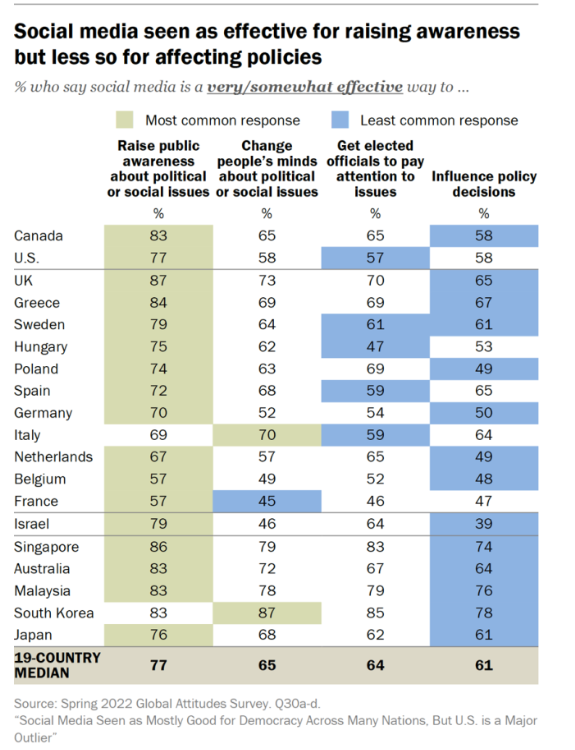
Source: Pew Research Center. Spring 2022. Global Attitudes Survey. 2. Views of Social Media and Its Impacts on Society
And, of course, the security and defense narrative must be strengthened. In this context, Ukraine can position itself not as a “problem,” but as a key component of European security—and therefore as an element, reinforcement of which is in the interest of Europe. Cooperation on defense technologies, sharing expertise on UAVs, supporting joint training programs for service members—these are all topics that should be emphasized as much as possible.
For Ukraine, it is critically important not merely to broadcast messages about its European future, but to do so in a way that creates a sense of common interests with citizens of Germany and other key countries. That sense of commonality will foster engagement—and engagement can gradually evolve into genuine support for Ukraine’s EU membership.
Photo: depositphotos.com/ua
Attention
The author doesn`t work for, consult to, own shares in or receive funding from any company or organization that would benefit from this article, and have no relevant affiliations