Between September 22 and October 5, Reform Index experts recorded eight reform measures. The most significant of these is a Cabinet of Ministers resolution requiring government agencies to notify citizens through the Diia application whenever someone accesses their personal data in state registers. This measure received a score of +2 points (on a scale from -5 to +5). Also highlighted in Issue 274 are updated standards for accounting for mineral resources and assessing deposits, which received +1.25 points.
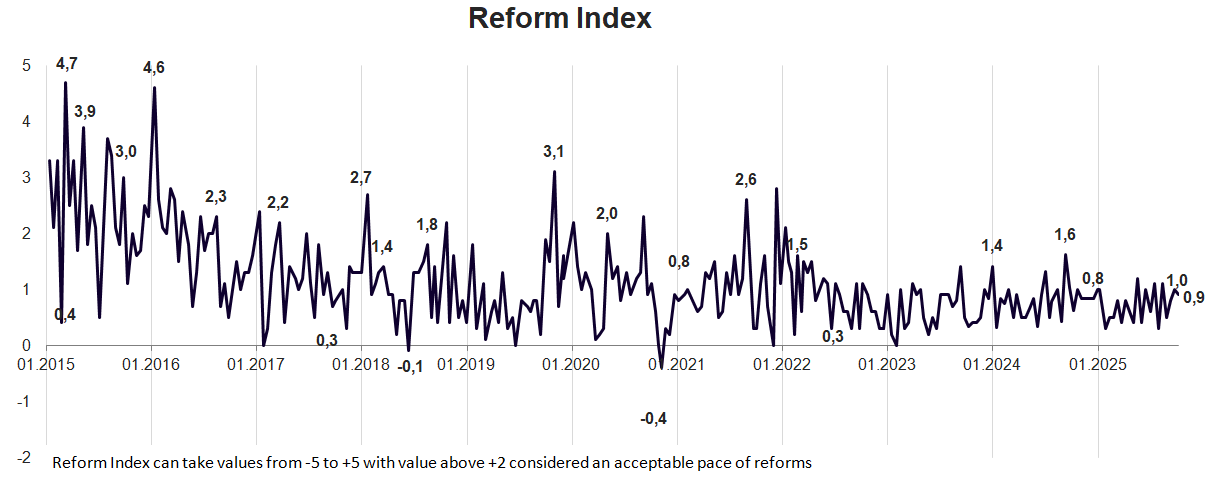
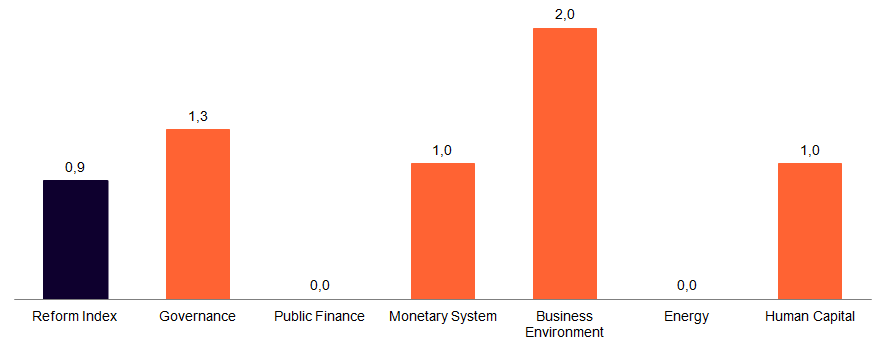
The overall Index score is +0.9 points, down from +1 in the previous issue.
Graph 1. Dynamics of the Reform Index
Graph 2. Values of the Reform Index and its Components in the Current Assessment Round
Ukrainians will be able to see who views their data in state registers, +2 points
Current legislation requires that citizens be informed about any requests for their data. However, in practice, the procedure usually works in such a way that citizens themselves must contact the register owner to obtain this information.
From now on, register administrators must notify users whenever their data is accessed. In other words, each time a request is made to a register, the individual will receive a notification in Diia indicating who — whether an individual or a government body — accessed their data. Ukrainians will be notified of all actions involving their information in systems integrated with Trembita, except when requests come from the NACP, relate to investigations or counterterrorism activities, or concern the medical sector.
Information about the Reforms Index project, the list of Index experts and the database of the regulations assessed are available here.
Expert commentary
Stanislav Yukhymenko, research fellow at the Institute for Economic Research and Policy Consulting
“Resolution No. 1244 responds to the need to give citizens control over their personal data. Previously, civil servants could view information in registers without a person’s knowledge, which created risks of corruption and did not comply with the GDPR — the EU’s General Data Protection Regulation (Articles 14–15).
The resolution changes the architecture of the Trembita system and introduces a dedicated monitoring subsystem. From now on, every request made by a civil servant will be recorded, and the citizen will receive a push notification in Diia with details about who accessed their data, when, and for what purpose. This innovation requires government bodies to state a clear purpose for each request to a register containing personal information.
At the same time, the resolution introduces exceptions: users will not receive notifications about requests made as part of pretrial investigations, operational or investigative activities, counterintelligence, or efforts to combat money laundering and the financing of terrorism. Requests in the medical sector and requests from the NACP are also exempt.
When implementing the resolution, there is a risk of digital inequality for those who do not use the Diia application. An alternative solution that provides access after authorization and identity verification should be created for such users.”
Updated rules for accounting for and evaluating mineral reserves, +1.25 points
On September 25, 2025, the government updated the rules governing the accounting and evaluation of mineral resources in Ukraine. Under the old rules, which had been in effect since 1997, resources and reserves were classified by the degree of geological exploration, industrial significance, and the level of technical and economic assessment. In other words, the previous system focused mostly on identifying and quantifying minerals without considering whether their extraction was economically viable or practically feasible.
From now on, reserves and resources will be classified according to a scheme that aligns with the United Nations Framework Classification for Resources (UNFC). When accounting for and evaluating reserves, in addition to the degree of geological exploration, factors such as socioeconomic and industrial significance, the level of project detail for extraction, and the degree of technological study and readiness for developing a given resource deposit will be taken into account. This means that information on reserves of oil, gas, metals, or other resources will now be assessed using clear criteria — how well the deposit has been explored (whether the indicated reserves truly exist in the stated volume), how much extraction would cost, whether implementing the project is reasonable given social, economic, and environmental conditions, whether the project is technologically ready, and so on.
In light of these factors, sites for development will be classified as viable (resources are well studied, extraction is economically feasible, and the necessary technologies are available), potentially viable (the efficiency of extraction and use cannot be determined definitively at the time of evaluation), and nonviable projects (extraction is unprofitable and technically complex).
Expert commentary
Roman Nitsovych, Dixi Group
“Updates to the 2019 UN Framework Classification for Resources (UNFC), which is a universal system for classifying mineral reserves and resources, will help provide clearer information to potential investors. In fact, using this system, the government has already verified reserves of critical and strategic minerals in Ukraine for unlicensed areas.
Importantly, these results are publicly available on the National Geological Web Portal. These assessments, together with the digitization of historical geological information, can support the re-evaluation and verification of reserves and resources in line with other internationally recognized systems and standards (CRIRSCO, NI 43-101, JORC).”
Reform Index from VoxUkraine aims to provide a comprehensive assessment of reform efforts by Ukraine’s authorities. The Index is based on expert assessments of changes in the regulatory environment in six areas: Governance, Public Finance, Monetary system, Business Environment, Energy, Human Capital. Information about the Reforms Index project, the list of Index experts and the database of the regulations assessed are available here.
Photo: depositphotos.com/ua

Attention
The author doesn`t work for, consult to, own shares in or receive funding from any company or organization that would benefit from this article, and have no relevant affiliations